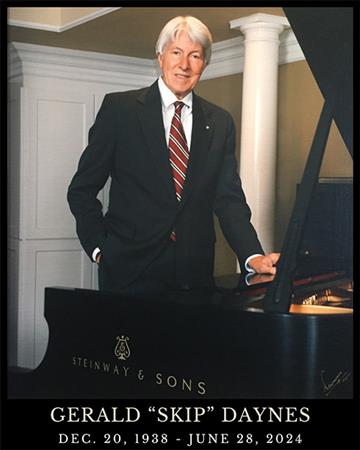
In a recent edition of the Salt Lake Tribune, Paighten Harkins reporter for the newspaper wrote about the closing of Dayne's Music. Skip a beloved Rotarian was highlighted in the article.
For six generations, the Daynes name has adorned Utah’s only Steinway & Sons piano shop. The family of England-born Latter-day Saints converts arrived in Utah in 1862 with a small organ they hauled across the plains in a covered wagon. They’ve been sharing music with Utahns ever since. That ends this spring. Daynes Music Co. is set to close as soon as it can empty its Midvale showroom of its dozens of glossy, handcrafted Steinway pianos. They began selling off their collection, with deep discounts, on Thursday. This isn’t just any Utah retailer. Daynes calls itself the state’s oldest family-run business. It has supplied top-of-the-market Steinways to schools and universities around the state, while hosting recitals and lessons in the store and supporting Utah music as a community hub for thousands of families.
“Things are in flux in the piano world,” said Kary Billings, executive director of the Gina Bachauer International Piano Foundation, the Salt Lake City nonprofit that hosts one of the world’s most prestigious piano competitions. “It’s a big loss,” he said. “A big, big loss.”
The music business has changed a lot since the Daynes family’s arrival, more than 30 years before Utah became a state. These days, people are less likely to play instruments, said Todd Daynes, a fifth-generation descendant of the founder. Technology has changed things. A new top-of-the-line Steinway piano can run from around $50,000 to more than $200,000, but there are far cheaper electronic options available. The sheet music that the store sells has transitioned. Electronic tablets often sit on music stands instead of loose-leaf pages or bound workbooks. And, many homes don’t have room for a piano that can be as big as a dining table.
Just last month, another local music store, Riverton Music, announced it was closing its West Jordan location, one of its three in the area. The company cited pressures from tariffs, and other inflationary trends. A few months ago, Guitar Czar, a longtime shop, closed for the same reason (and later reopened as a repair shop).
The music market is tough. “But that’s not the reason we’re closing,” Todd Daynes said. “The irony is, the company is probably in better shape than it’s been in 100 years,” he said. “And we’re choosing to close it.”
On a recent March afternoon, as news of Daynes’ upcoming closure was starting to trickle through Utah’s piano community, Todd Daynes, his mother Susan and CEO Kerwin Ipsen met at the shop to explain the decision. It comes down to time and commitment. Since the death of patriarch Gerald R. “Skip” Daynes in 2024, Todd Daynes said, the family has run out of members interested and able to run the store. The family entertained alternatives, such as selling the business or its name to someone else, Susan Daynes said. But they worried what might happen to the family name if it was out of their hands.
“The way my father ran the business was a way that businesses aren’t run today,” Todd Daynes said. “If you take what my father did, and you incorporate it in some non-hands-on, unfriendly kind of internet-age environment, that’s not what he would want his company to be. “The last thing we wanted to do was to sell the store to someone that would ruin it,” he said. Still, it was a hard decision. In a state that commonly boasts the most pianos per capita in the U.S., where Daynes’ pianos have furnished so many classrooms, concert halls, hospital lobbies and homes, losing this Utah institution will leave a hole the size of a concert grand, some music educators told The Salt Lake Tribune.
“That’s a cross that I will bear, and who knows what happens in the hereafter, if I get scolded,” Todd Daynes said, his mother laughing. “But we just can’t continue.”
‘The music is what binds us’
On this Thursday afternoon, word that Daynes was closing started to make the rounds. Eugene Watanabe, a longtime customer, stopped in to say goodbye. He and Susan Daynes hugged like old friends. Watanabe, who co-founded Salt Lake City’s Gifted Music School with his wife, Vera Oussetskaia Watanabe, said the impact of this store on the community was “truly profound.” A number of Latter-day Saints pioneers, like the Dayneses, brought instruments with them, and “music is one of the ways that the culture grew and kept its values,” he said. “It has nothing to do with whether one is LDS or not LDS,” he continued. “The music is what binds us.” And the instrument that Daynes provided — the Steinway — is the instrument that “defines what a piano, in many people’s eye, is.” Watanabe’s visit was more than just saying goodbye. He wanted to see if he might be able to buy some pianos for his school, which has some Steinways that are on the older side. “Maybe this is Skip saying from beyond, from the other side, ‘You guys need these,’” Watanabe said.
Jihea Hong-Park, an associate piano professor at Brigham Young University, told The Tribune, “They were never just a piano store.” Daynes was also a gathering place, recital hall and learning center that supported students and teachers alike. “I’m going to miss walking into Daynes and being greeted by my first name,” she said. Hong-Park said that one of her students told her last week that he was going to Daynes to buy sheet music one last time. “Nothing compares to the feeling of flipping through the pages of your favorite pieces,” she said. “I’m going to miss that about the store too.”
Billings, with the Bachauer International Piano Foundation, said Daynes has loaned every piano — eight of them, four times a year — for their concerts and competitions. The foundation also hosts school events, where pianists visit Utah schools to teach music. Daynes hauled those pianos into school cafeterias, letting 20,000 kids a year across the state see and touch these one-of-a-kind instruments, he said. “We always wondered if this day might come, and we just never dreamed it would be here this soon after Skip passed,” Billings said. Yu-Jane Yang, director of keyboard studies at Weber State University, said she went to the Daynes store at least once a month. It’s where she recommended students buy their sheet music, and where she attended recitals and met with other pianists. “I just don’t know how to imagine the state without that store,” she said.
Steinways are renowned, but it can be hard to explain their appeal to the untrained ear, Yang said. When a pianist sits at a bench, they are thinking about how their music will sound. “Those are the things that you first imagine in your head, that’s what you want to do with your training and your interpretation, but you need the tool that can make that a reality.” Skip Daynes couldn’t play piano, but he understood that about Steinways. That’s why he wanted to get these instruments beneath the fingers of as many students and elite performers as possible. He was also instrumental in many of the state’s universities — including the University of Utah, Weber State,Utah State, Utah Valley, Snow College and Southern Utah — becoming “Steinway Schools,” a designation given when a program’s entire selection of pianos, from its practice rooms to its concert halls, are Steinways.
Brigham Young hears a Daynes at the keyboard
The Daynes story starts in England, where John Daynes and wife Eliza Miller lived with their son Joseph J. Daynes. John Daynes was a piano hobbyist, and the family kept one in their home. His son, as the stories go, showed an aptitude for music beyond his years. During the boy’s early years, the family became members of The Church of Jesus Christ of Latter-day Saints, and headed to Utah in 1862. Before beginning the trek, John Daynes bought a melodeon, a small, foot-pumped organ, and a concertina, like a tiny accordion, and packed them for the journey. Young Joseph J. Daynes played tunes across the journey. Ipsen, the store’s CEO, joked that this was the only wagon with its own stereo.
It was fortuitous timing. Joseph J. Daynes arrived in Utah as the tabernacle organ was being built, and Brigham Young, the church’s president, was looking for an organist. One day, Young happened upon Joseph J. Daynes playing his melodeon in Eighth Ward Square, near what is now Salt Lake City Hall, and knew he’d found the player. “There is our organist for the great Tabernacle organ,” Young said. Five years later, when Joseph J. Daynes turned 16, he took the role as organist – and played for 33 years.
While the son played with the choir, the father ran the family store. That first log-cabin shop housed three specialties: eyeglasses, watches and pianos. About a decade after the Daynes’ arrival, the shop became the first Steinway dealer in the mountain West when John Daynes had one shipped from San Francisco to Salt Lake City, crossing Donner Pass on the way. John Daynes, like many Latter-day Saint pioneers, had multiple wives. The family split into three branches: music, jewelry, and optical after a feud so old, the music side of the family doesn’t know what started it. Gerald R. “Skip” Daynes took over the piano business in 1968, when his father, Gerald R. “Jerry” Daynes, became ill. He embraced the job.
Todd Daynes said his ancestors may have had a sense of the entrepreneurial opportunities in this new territory. But there was something else too. “They had the music in their blood.” During Skip Daynes’ tenure, he and his small crew would also transport the pianos they were providing for free to the Bachauer and other competitions. It’s backbreaking work. “We didn’t get any money in return, but he got to feel good from helping the arts. There’s no one in their right mind – because he probably wasn’t in his right mind when he was doing this – that will do it now,” he joked.
Voices from beyond
Standing in her late husband’s old office, Susan Daynes recalled a fateful trip to Washington D.C. he made decades ago to deliver a piano to WordPerfect co-founder Bruce Bastian, after the classical trained pianist and software trailblazer donated more than $1 million to transform the U. into an all-Steinway school. It was a hot, muggy day, and Daynes was exhausted. He thought, ”I’m going to sell this business. It’s too hard.’” But then, she said, Skip Daynes felt the hairs on the back of his neck stand up, as if Joseph J. Daynes was chastising him, telling him, “You will not sell the business.” So, he didn’t. He worked at the shop until the day he died, Susan Daynes said. This time around, Susan Daynes said she hadn’t felt any hairs stand up on the back of her neck.
Billings said that there will be a new Steinway dealer in the state soon. He is looking forward to working with them. However that relationship works out, it won’t be Daynes.
article credit - Paighten Harkins, Salt Lake Tribune -Article Link - Daynes Music closing: Utah’s longtime Steinway piano dealer shutting down